
How to verify a counselor's license and credentials in South Carolina
By David Reyes · Updated 2026-07-12
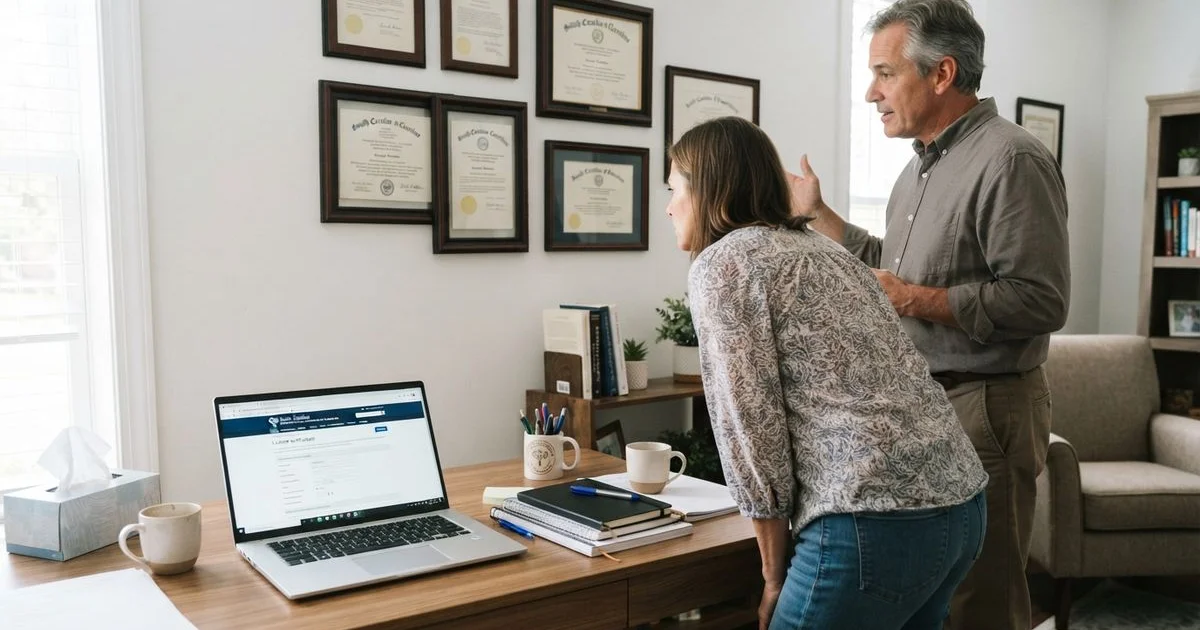
Most people never think to check a counselor’s license before booking, and most of the time nothing goes wrong. It’s still worth the few minutes it takes, especially before committing to ongoing sessions or handing over payment for a package of visits, and it’s a step worth taking regardless of how the practice presents itself online.
Why this matters
A license means the person met specific education, supervised-experience, and examination requirements set by the state, and that there’s a regulatory body you can contact if something goes seriously wrong. It doesn’t guarantee good chemistry or a good fit, but it does confirm a baseline of accountability that an unlicensed provider doesn’t carry.
Where to check
The South Carolina Department of Labor, Licensing and Regulation (LLR) oversees licensing for counselors, social workers, and marriage and family therapists in the state, and maintains public records you can search. Confirming a license takes three pieces of information: the person’s full legal name, the credential type they claim to hold, and ideally their license number if you have it.
Common credentials and what they mean
| Credential | What it generally means |
|---|---|
| LPC-A (associate) | Working toward full licensure under required clinical supervision |
| LPC (Licensed Professional Counselor) | Fully licensed to practice independently after meeting education and supervised-experience requirements |
| LMFT (Licensed Marriage and Family Therapist) | Licensed with a specialization in couples, family, and relationship-focused treatment |
| LISW (Licensed Independent Social Worker) | Licensed to diagnose and treat independently, without required clinical supervision |
| Psychologist (PhD/PsyD) | Doctoral-level training with its own separate licensing board |
None of these credentials is automatically “better” for every situation. An associate counselor under active supervision can be an excellent, well-matched provider. The point of checking isn’t to rank credentials, it’s to confirm the person is who and what they say they are.
What to do if something doesn’t add up
If a name doesn’t turn up in the state lookup, that’s not automatically disqualifying, since practices sometimes market under a different name than the individual clinician’s license. Ask the practice directly which specific licensed person will be seeing you, and verify that name. If a provider is practicing via telehealth from another state, ask which state’s license applies and check there instead.
If a practice is reluctant to answer a direct, reasonable question about licensure, treat that as useful information on its own, separate from anything else about the practice.
What a license lookup actually tells you
A state license record generally confirms the credential type, whether it’s currently active, and whether there’s any public disciplinary history on file. It won’t tell you about a counselor’s personality, communication style, or whether their approach fits you personally, since those are things you can only judge from talking with them directly. Think of a license check as confirming the floor, the baseline of training and accountability, not as a substitute for evaluating fit once you’ve had a session or two.
Interstate telehealth and licensing
Telehealth has made it more common to see a counselor licensed in a different state than where you live. Most states require a counselor to hold a license in the state where the client is physically located at the time of the session, not just where the counselor’s office sits. If you’re considering telehealth with a provider based elsewhere, it’s reasonable to ask directly whether they’re licensed to see clients located in South Carolina, since the answer affects whether the arrangement is actually compliant.
Verifying is a normal step, not an insult
Asking about licensure sometimes feels like an accusation, but it isn’t one. Reputable practices answer this question routinely, often listing credentials directly in their bio or on their website. A quick check before your first appointment costs little and confirms you’re working with someone accountable to a real licensing board, which matters more once real money and personal information are involved.
Verifying credentials matters just as much when the client is a minor. Our guide on teen counseling consent laws in South Carolina covers the separate legal questions that come up for parents and teenagers.
Columbia SC Counselor Guide lists reported credentials for local providers alongside reviews, evaluated using our scoring method, which can help narrow your search before you verify a specific counselor’s license yourself and book that first appointment with confidence.
Frequently asked questions
- Where do I actually check if a counselor is licensed in South Carolina?
- The South Carolina Department of Labor, Licensing and Regulation (LLR) maintains public licensing records for counselors, social workers, and marriage and family therapists. Their license lookup is the most direct way to confirm someone's status.
- What's the difference between an associate-level license and a full license?
- An associate license (like an LPC-A) allows supervised practice while someone works toward full licensure. It's a legitimate, common stage, not a red flag, but it does mean the person is practicing under a supervisor's oversight rather than fully independently.
- Is it a problem if a counselor's license is listed under a different, similar-sounding name?
- Not necessarily. Practices and marketing names sometimes differ from the name on a license. If you're unsure, ask the practice directly which licensed individual will be seeing you, and verify that specific name.
- What should I do if I can't find a counselor's license in the state database?
- Ask the practice directly for their license number and issuing state, especially if they're licensed elsewhere and practicing via telehealth. If they can't or won't provide it, that's a legitimate reason to look elsewhere.